Just updated my companion apps and started a mining session, Datum showing a large difference between local shares accepted and pool shares. Anyone seen this before?
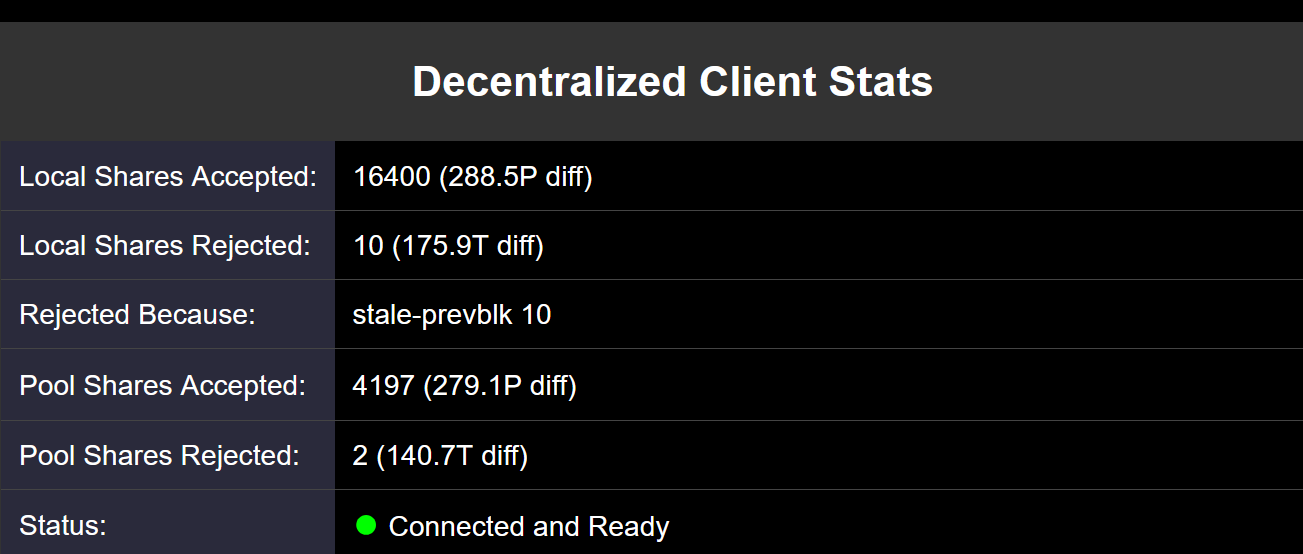
Yes, this is a new update that I added (PRs submitted to upstream as well, so this will probably become the standard), where the difficulty that Datum Gateway gives the worker is taylored to their hashrate. This makes the ASIC mine more smoothly (and it prevents disputes on MRR from going against you with the reason “difficulty too high”). Datum Gateway only submits those shares to the Datum pool which are above the pool’s difficulty (which for slower ASICs is typically higher than the difficulty that Datum Gateway gives them).
More details are in the upstream PR here if you are interested.
3 Likes
Appreciate the info, thanks Paul
My 2c’s
For the Lazarus pool I dropped the difficulty to 4096 (recommend by the pool as the floor). Since I use MRR’s site directly I also added filter to the sort function of the rental page and capped the difficulty at 8192. This does reduce a lot of higher output rigs (20Th+) being shown to me which is just fine.
As long as I stay between 4096 and 8192 the rejection rate stays in the single digits… New sessions start at difficulty 4096 and vardiff steps up toward my hashrate from there". I set the difficulty back to stock (16384) in the gateways I get a lot more rejections as depicted in my screen grab. Means a bit more baby sitting the rentals hands on but such is life.
I have an HS Box and it’s recommend difficulty is 4096. I get zero rejections but that is also a direct connection to my node on my network vs using HAShGG stratum does appear to report more Local share rejections. I figured it was the playit stratum port.
Ill be reading the PR for more details. Thanks @paul
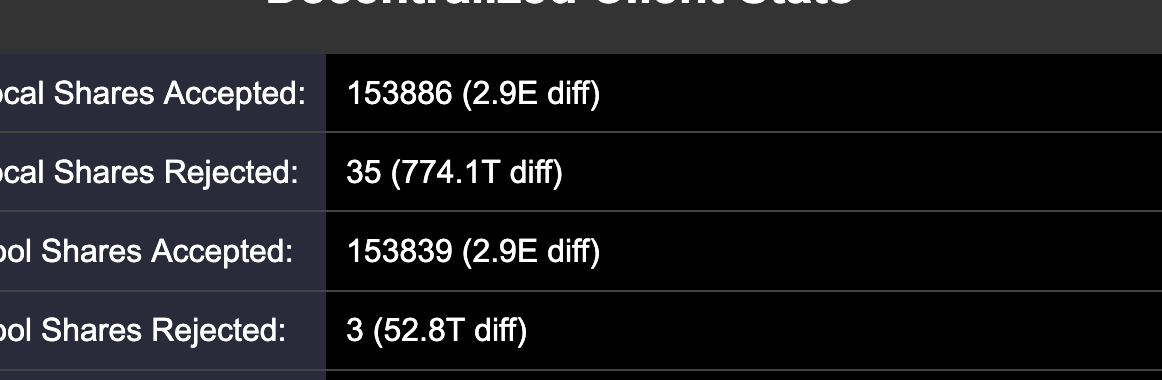
The update combines with my earlier update which allows setting the difficulty with password “d=…” Pickhash looks at MRRs suggested hashrate for each rig, gives them a relevant password for that difficulty, and now allows the rig to mine at a much lower difficulty than the pool allows. This is particularly important when mining with a lot of rigs or a combination of high hashrate and low hashrate rigs, since the pool otherwise dictates one difficulty that applies to all rigs (which creates a problem for the slower rigs, or is too high for everyone when there are a lot of rigs).
1 Like