Trying to be sure I understand how this works. I have to relearn these things as brand new at times since easy for 2 months to go by between efforts. Constant struggle to connect thinking through what to do and actual execution of the thing.
I want to move my cold storage BTC from the replay threatened cold storage address to separate sha256 and Blake2b addresses. First question, is this how this works, can I do this? Should I do this? Concern is when you’re
If so, my situation: I jumped off an set up Knots Blake2b node (24.1.4: on my (updated) start9 server, got my HS box running, ran my ethernet, all connected and ready to go. BUT I understand to replay protect my cold storage BTC I need to send it to myself (to another cold storage address). To move it and protect myself, I need my Knots/RDTS node (https://bitcoinknots.org/files/29.x/29.4.1.knots20260508/) to make the transaction invalid on the Blake2b chain, correct?. (Add an OP_return > 83b)
If so, do I have to roll everything back (uninstall/stop my Blake2b setup, re-setup my Knots/RDTS node just to make this happen? Can you run them in parallel?
If so, and I move this BTC to a new sha256 cold storage address, what happens to my Blake2b BTC? How do I access that and get into a wallet? And do I use Shrike to do this or does Sparrow support sha256 and Blake2b, now?
It’s painful sorting this out in fits and starts. I don’t recommend it. Thanks for any help.
I’m posting Paul’s notes from another forum. I hope he doesn’t mind. These are his instructions, however, it didn’t work for me. I’m waiting on a reply from him for some clarifications but here you go. I hope its helpful:
"This is maybe obvious, but it just occurred to me today that there is a very simple option for replay protection that doesn’t require a a hardware wallet with updated firmware supporting unified sighash. All you need is Shrike or Sparrow BLAKE2b:
Create a new hot wallet in Shrike/Sparrow BLAKE2b
Send a small amount from your cold storage to the new hot wallet (something insignificant, not dust, but no need to risk anything here)
Send everything from the hot wallet back to cold storage, with unified sighash selected (make sure it shows Replay protected)
Now do a consolidation transaction in your cold storage, combining the replay protected UTXO you just sent to yourself with any other UTXOs that you want to also be replay protected.
The output from #4 will be replay protected UTXOs in whatever size you need, that never left cold storage, and never required a hardware signer that supported unified sighash."
Thanks, @MacroMan. Yes, that is the simplest process, which doesn’t put your stack at risk (if you have it in cold storage). If your stack is already in a hot wallet, then you can do this way more simply, but loading the hot wallet into Shrike or Sparrow Blake2b, and then sending your stack to yourself with unified sighash selected.
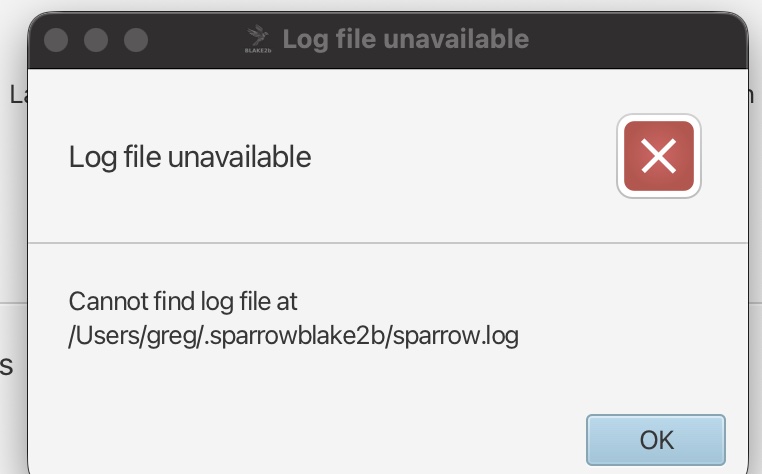
Yes, two issues. The UI is looking for “sparrow.log” instead of “sparrowblake2b.log”. I’ll fix that.
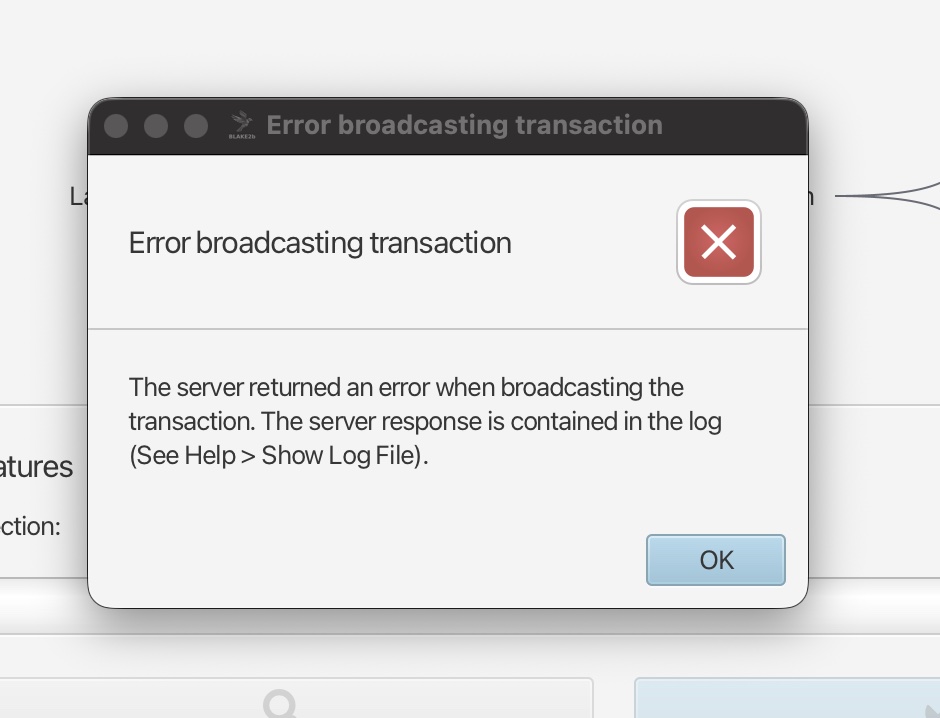
The original error is most likely that the UTXOs you are spending have not reached maturity (currently 45 days, likely to be extended to 1 year, depending on how Luke’s poll turns out). You mentioned mining rewards – those are the ones which are locked. I’ll update Sparrow to call this out in the UI without needing to look at the log file.
Ah…so If Im reading you correct ALL rewards I have are locked??? Rewards I tried to send were from 9-11-26…or was lock activated at a certain block height?
Luke wrote this soft fork in a weird way where it back-applied to all coinbase UTXOs that had not already been spent prior to the fork. So the logic went into effect at a particular block height, but back-applied to ~45 days of blocks before that height. Presumably, if it is extended to 1 year, the same would apply. I assume this was to have an immediate, retroactive impact on Alpha Pool.
Yes, I am working on a way to enforce Datum Gateway and make it expensive for a pool to spoof. I’m hoping to get that in front of Luke before he activates the 1 year (since the entire goal of this exercise is to disincentivise any pool that is not having the pool members build their own block templates). It is complicated though, and they are moving very fast over there (and Luke may not agree that it solves the problem), so for now, I would recommend assuming that freshly mined UTXOs will not be spendable for 1 year.
Freshly mined means anything after 8/8 that was not spent before the 45 day soft fork and all utxos going forward for 1 year with the next purposed soft fork.
How then are lightning channels getting funded? Are they “bought” sats from the exchange Neoxa?
Yes, the only way to get sats currently are through the exchange, folks sending them to you, or through fees for various services. There isn’t really a lot of commerse on the new chain yet, but presumably you could sell products or services to other members who have mature UTXOs to spend.
One way you could get liquid BLAKE2b sats more quickly from your mining rigs would be to rent your BLAKE2b ASICS out on MRR which pays out in SHA256 sats (which you could then exchange for BLAKE2b sats on Neoxa). You would lose quite a bit to fees along the way, but might be worth it if you needed liquidity from the rigs sooner and were willing to take a haircut.
Hmmm… it might be possible to create a pool which manages this process for you (basically it would be a very high-fee pool that provided immediate liquidity). This probably would be acceptable by the BLAKE2b community since any hashers who used this service would most likely be rented by low time-preference folks who are running Datum Gateway, creating their own block templates, and willing to wait for the long coinbase maturity (rather than that hash rate going to a centralized high time-preference Stratum pool)
So, steps 1-4 move only BLAKE2b back and forth. This process separates my BLAKE2b sats from the sha256 sats and now they are completely differentiated and disassociated from each other on separate UTXOs, correct?
I haven’t looked at my sats on my cold wallet since all of this went down. I’m curious if I upgrade firmware so it supports unified sighash, does this mean I will see to 2 different bitcoins on my wallet before I do anything? After, same?
Hot wallet suggestions? Matt Kratter has me essentially terrified of using hot wallets. What do you suggest / how setup or I’m sure there is already a thread on this…? I’ve played around with Sparrow and Shrike, but not setup a wallet before. Can I use the the Knots built-in wallet?
The reason for only sending a very tiny amount to the hot wallet is to de-risk the whole process. That way if the hot wallet get compromised, you are only out that tiny amount. Don’t send your whole stack to a hot wallet.
Ok, so you started with a Ledger cold wallet in Sparrow. Did you create that same Ledger cold wallet in Shrike? And if so, were the transactions listed in both Sparrow and Shrike identical before you proceeded to step 2?